Saturday, June 27, 2020

An Interview with Geoff Dyer

Geoff Dyer: “There should be an annual festival devoted to me”
Geoff Dyer


An Interview with Geoff Dyer


Brick 84
Posted on January 1, 2010


Over the past two decades, Geoff Dyer has set up camp in so many sections of the bookstore as to merit special recognition, something that could serve as a reward for such valiant commercial self-sabotage. His books vary in genre from music, war, photography, and travel, to fiction and literary biography. No single zone of interest towers above the others—he’s not the poet who also wrote a curious little volume on marine biology, or the critic who took a stab at memoir. Dyer’s singular sensibility unites this body of work; one that incorporates his frustration with the writing process into the narrative, and does so with humour, irreverence, and insight.
Geoff Dyer’s most recent book is Jeff in Venice, Death in Varanasi, a novel in two parts. He was part of the Authors at Harbourfront Centre series in Toronto in April 2009.

Brick 84


Teodoro: The protagonist in Jeff in Venice claims that interviews work better if the interviewer pretends to be a complete numbskull. I don’t know that I’ve ever tried that technique. I wonder if I should try saying something really stupid about now.

Amith Chaudhuri / The Casual Moment

Primera de la trilogía de la caballería de J. Ford. (con imágenes ...


The Casual Moment


Brick 75
Posted on June 14, 2018

I always find it a bit surprising when I hear the directors and producers of Hindi films say, “This one is very good—it’s almost as good as Hollywood.” I realize it’s probably a quality of professionalism, a technical finesse, they have in mind; because, creatively, mainstream Hollywood cinema today is arguably the least interesting and most infantile cinema being made anywhere. Its success might be an object of emulation—but does it compel admiration in any other sense?
Brick 75For ever since we can remember, Hollywood has been not only a principal producer, but also the chief definition of popular cinema. But, in the last twenty years or so, it has become more: it has become, almost unobtrusively, a universal type. I feel this especially when I am in the DVD and video section of a book or music shop in Britain—there is cinema, and then, in a corner, there is “world” cinema. What’s happened to the adjective “world” here is striking: robbed, both physically and conceptually, of size, volume, and mastery, of the glamour it possesses in other conjunctions (“world famous,” “world class”), it has become a ghost of itself, an uncharacteristically minor term. The “world” is an obscure and down-at-the-heel Hollywood suburb, which people, these days, visit infrequently.

Thursday, June 25, 2020

Russell Banks on Mavis Gallant’s Montreal


Russell Banks on Mavis Gallant’s Montreal


The Stories of Mavis Gallant


Posted on June 1, 2004


In a characteristic mingling of modesty and fierce pride, Mavis Gallant has said that “one of the hardest things in the world is to describe what happened next.” It’s hard because of the value- and emotion-laden nature, not just of memory, but of human consciousness itself. Though nothing truly escapes us, memory and mind from the moment of our birth are notoriously, almost hopelessly, selective, elliptical, and inventive. And memory and mind, for expression, perhaps for their very existence, depend upon language—than which, of course, there is no more evasive and deceptive a medium. Now in her eighties, Gallant has spent a long lifetime doing that hardest thing—describing what happened next—in stories that are not only moving and powerful but also true to memory and mind. Born and raised bilingual in French-speaking Quebec and residing most of her adult life in France, Gallant chose to write in English, and in it less than a handful of living story writers are her equal: William Trevor, and Gallant’s countrywoman Alice Munro, perhaps, and—since the death of Eudora Welty—no American that I can think of.


The tension—and sometimes outright conflict—between remembered and felt experience on the one hand and, on the other, the known truth of what happened lies at the heart of all great short stories. It’s the argument that generates plot and structure, which, finally, gives a story meaning. Since Gogol and Chekhov, the flexible and still rapidly evolving form of the short story has unfolded that argument, and in doing so, it has universalized and dignified the experience, the pain and sorrow and desire and fear, of the ordinary, solitary man, woman, and child. It has extricated the isolato from the masses and made Everyman. Frank O’Connor called the modern short story “the lonely voice,” and more than any other literary form, it speaks to and for every human being who thinks of him- or herself as alone, cut off from God, and counted as unimportant and unworthy of attention except when considered en masse. It is, in a sense, the most democratic literary form. And it is in this tradition that Mavis Gallant has made herself a master.
Her stories follow no formula and obey no laws other than Robert Musil’s “one law of life, and that is the law of narrative order.” Which is to say, they are digressive, regressive, and circular; they leap forward in time one minute and linger in pockets of loss the next; they ruminate and fulminate and explicate. There are asides, self-reflexive inquiries, and rapid shifts in point of view—none of which stop or hinder the forward motion of the story. Quite the opposite; they keep the story flowing, like a meandering stream crossing a broad plain to the sea, like consciousness. But Gallant’s intent is always to dramatize consciousness, not merely to portray it. Consequently, her stories are as difficult to describe or to reduce to a synopsis as any truly lived experience is—not because of their variety or obscurity (her stories are never obscure) or some esoteric quality (her characters, settings, situations, and language are always instantly familiar, intimate, and homegrown, whether planted in Montreal, an Eastern Township village, Paris, Moscow, Florida, or the French Mediterranean), but because of their economy and precision and the sublime integration and inseparability of their elements—form, structure, content, and style.


In terms of locale, her stories, perhaps as a reflection of her somewhat bifurcated life, can be divided roughly between those that take place in Europe, usually Paris, and those set in Canada, usually Montreal and its environs. I have for personal reasons (I am half Canadian with three Canadian grandparents and grew up and live today just south of the border) an abiding affection, if not an outright preference, for the North American stories, if only because Gallant has attended there to lives that are familiar and matter greatly to me and rarely make it into literature: an adolescent girl, nearly crushed by the claustrophobic religious culture of her family, refusing to exchange her spirit for her soul (“The Chosen Husband”); a boy, abandoned by his feckless dad but obliged to care for the old man when, years later, he turns up dying in France (“The End of the World”); a grown daughter, returning to the city of her childhood, tracking the secret sources of her gauzy memories of her father and mother and their torn marriage (“Voices Lost in Snow”). None of these characters has money or property or much education; none of them is secure in society. Characters and situations like these seem peculiarly American, North American. It’s not easy to imagine them in the hands of a British or European or Latin American writer. I fear they would be treated far less kindly.
In Gallant’s stories, the conflicts, obsessions, and concerns—the near-impossibility of gaining personal freedom without inflicting harm on those whom you love and who love you; the difficulty of forgiving a cruel and selfish parent without sentimentalizing him; or the pain of failed renewal—are limned with an affectionate irony and generated by a sincere belief in their ultimate significance, significance not just for the characters who embody them, but for the author and, presumably, the reader as well. Such themes and perspectives as these have characterized the work of the best American story writers of the last half-century, from John Cheever to Raymond Carver to Lorrie Moore, and the best Canadians, from Alice Munro to Margaret Atwood to Clark Blaise. We respond to them on both sides of the long, porous border between our two nations with the same sad shock of self-recognition that we feel contemplating the imagery and atmosphere of a painting by Edward Hopper or a Duke Ellington orchestral suite. There is stringently expressed nostalgia, and then a bite, a redemptive edginess, that by undercutting the nostalgia gives it dignity and makes it worthy of our attention and admiration. As Samuel Beckett noted, “There is no escape from yesterday because yesterday has deformed us, or been deformed by us.” The memory doesn’t simply linger on; it instructs the present and prepares for the future that will sabotage it.
Here is Gallant:
The end of the afternoon had a particular shade of color then, which is not tinted by distance or enhancement but has to do with how streets were lighted. Lamps were still gas, and their soft gradual blooming at dusk made the sky turn a peacock blue that slowly deepened to marine, then indigo. This uneven light falling in blurred pools gave the snow it touched a quality of phosphorescence, beyond which were night shadows in which no one lurked. There were few cars, little sound. A fresh snowfall would lie in the streets in a way that seemed natural. Sidewalks were dangerous, casually sanded; even on busy streets you found traces of the icy slides children’s feet had made. The reddish brown of the stone houses, the curve and slope of the streets, the constantly changing sky were satisfactory in a way I now realize must have been aesthetically comfortable. This is what I saw when I read “city” in a book; I had no means of knowing that “city” one day would also mean drab, filthy, flat, or that city blocks could turn into dull squares without mystery.
(“Voices Lost in Snow”)
Time is the great subject of all Gallant’s work, but we also see how much she is a writer of the American North, of the region and culture that overlap the U.S.-Canada border from Maine and the Maritimes all the way west to Seattle and Vancouver. In these stories, darkness comes early and stays late; summer is not a condition, it’s an all-too-brief holiday. Cities are grey, skies are mauve or milky, and there are always wet boots slumped in entryways.
Many of the stories take place in Montreal, the city of Gallant’s childhood, and its suburbs. Born there in 1922 to English-speaking, Protestant, middle-class parents, she was an only child who, at the age of four, was sent for several years to a French Catholic boarding school; whose father died early, and whose mother quickly remarried. She was, as she says, “set afloat.” Consequently, from the beginning she has been situated simultaneously inside and outside her given worlds, a person forced to navigate her way on her own along the straits that lie between children and adults, men and women, and family and strangers; between the French language and English, provincial Catholic culture and urbane humanism; between Canada and the United States, and North America and Europe. Gallant’s life has placed her at the Borderlands, the ideal site for a writer of short stories.
It’s apparent from Mavis Gallant’s fiction that, like Henry James, nothing is ever lost on her, for she seems to have remembered everything that occurred in Montreal in the 1930s and 1940s and everyone whom she even so much as glanced at. It should not surprise us that she has been, especially for her time and place, an unusually independent woman. For six years, she worked as a reporter for the Montreal Standard. She married young, soon divorced, and in the late 1940s, started publishing her first stories in Canadian literary magazines. In 1950, at the age of twenty-eight, she made the bold decision to run off to France and live as a fiction writer, saying of that move simply, “I have arranged matters so that I would be free to write. It’s what I like doing.” Which, while guarding her privacy and solitude with care, is what she has done ever since.
With gratifying regularity, her stories have appeared in the pages of The New Yorker for nearly five decades now (which fact alone justifies the existence of that magazine); she has won numerous prizes and awards, yet here in the United States, despite having long been ensconced at Parnassian heights, she has mostly been viewed as “a writer’s writer.” Surely this is due more to her residency abroad, her absence from book-chat circles, and her well-known aversion to intrusions on her privacy than to any particular difficulty or preciousness or exoticism in her work. For what is a writer’s writer, anyhow? Merely one who honours in every sentence she writes the deepest, most time-honoured principles of composition: honesty, clarity, and concision. So, yes, in that sense she is a writer’s writer. But only in that sense.
Many of Gallant’s stories are “Canadian,” not by virtue of where they are set, but only because their protagonists happen to hail from that country, regardless of where they turn up in the world of the story. Gallant is fond of revisiting characters, viewing them at different times and places and from different points of view, producing sequences of three or four or more stories about the same individual and his or her family members and giving an almost novelistic take on their individual and familial histories, all the while remaining faithful to the short story form. Among such story sequences are the Montreal stories about Linnet Muir; the set about the Carette sisters, Berthe and Marie; as well as a new sequence of three extraordinary stories, “Let It Pass,” “In a War,” and “The Concert Party,” narrated by a man, un homme d’un certain âge, whose life’s story and sad fate ought forever to disabuse any critic of suggesting that Gallant is hard on her male characters. Ironic, perhaps, but always sweetly forgiving. The Linnet Muir and Carette sisters stories are justly famous and often anthologized.


In an afterword that appears in her collection Paris Stories, Gallant says, “Stories are not chapters of novels. They should not be read one after another, as if they were meant to follow along. Read one. Shut the book. Read something else. Come back later. Stories can wait.” Yes, but believe me, Gallant’s can’t.


Russell Banks is the author of eighteen works of fiction, including the novels Continental Drift, Rule of the Bone, and Lost Memory of Skin, as well as six short story collections, most recently A Permanent Member of the Family. He lives in Miami, Florida, and in upstate New York with his wife, the poet Chase Twichell.

BRICK


DRAGON

RIMBAUD

DE OTROS MUNDOS

CUENTOS


An Interview with Mavis Gallant


An Interview with Mavis Gallant

Excerpts


TRANSLATED FROM THE FRENCH BY WYLEY POWELL


I must confess at the outset that I was rather terrified of interviewing Mavis Gallant.
I had been a long-time admirer, knew the extreme rigour with which she undertook her work, and, most of all, from my research, sensed that she did not suffer fools gladly. In fact, I knew that she preferred to have her work speak for itself, and that she did not view literary criticism as an art form. Her choice has always been to concentrate uncompromisingly on her craft, to search for that perfect architectural form that lies in a great story. You have to come prepared: a great challenge . . . and a minor source of stress.
We agreed to meet at the apartment of one of Gallant’s Parisian friends, for the author’s apartment was her inner sanctum. A choice I of course respected, although I admit I wish we could have shown Contact’s viewers a glimpse of Gallant’s private world. 

Charles Dickens / Preface to Barnaby Rudge


Charles Dickens Art - Assassin's Creed Syndicate Art Gallery (con ...
Charles Dickens


Preface to Barnaby Rudge


Brick 84
Posted on January 1, 2010

The late Mr Waterton having, some time ago, expressed his opinion that ravens are gradually becoming extinct in England, I offered the few following words about my experience of these birds.
Brick 84The raven in this story is a compound of two great originals, of whom I was, at different times, the proud possessor. The first was in the bloom of his youth, when he was discovered in a modest retirement in London, by a friend of mine, and given to me. He had from the first, as Sir Hugh Evans says of Anne Page, “good gifts,” which he improved by study and attention in a most exemplary manner. He slept in a stable—generally on horseback—and so terrified a Newfoundland dog by his preternatural sagacity, that he has been known, by the mere superiority of his genius, to walk off unmolested with the dog’s dinner, from before his face. He was rapidly rising in acquirements and virtues, when, in an evil hour, his stable was newly painted. He observed the workmen closely, saw that they were careful of the paint, and immediately burned to possess it. On their going to dinner, he ate up all they had left behind, consisting of a pound or two of white lead; and this youthful indiscretion terminated in death.

Wednesday, June 24, 2020

'This is the best moment of my life,' he said, lying in the bath / Ian Holm remembered


Actor’s actor … Ian Holm in King Lear at the National Theatre in 1997. Photograph: Robbie JacK

'This is the best moment of my life,' he said, lying in the bath: Ian Holm remembered


Richard Eyre, Anne-Marie Duff, Ken Stott and Hugh Hudson pay tribute to the screen and stage actor who died on Friday


Richard Eyre, Anne-Marie Duff, Ken Stott and Hugh Hudson
Mon 22 Jun 2020 13.03 BST


That sense of emotional ruthlessness was what made him such a brilliant Lear

Richard Eyre
Ian Holm was, as it was so often said, the actor’s actor. Not because he was virtuosic, meticulous, droll and charismatic, all of which he was, but because he always drew the audience in, he always withheld something mysterious – something under the skin, something of the soul – and the audience always came to seek it. It’s no surprise that he was Harold Pinter’s favourite actor.

Yayoi Kusama / Infinity Mirror Rooms


TATE MODERN
EXHIBITION

YAYOI KUSAMA: INFINITY MIRROR ROOMS

UNTIL 9 MAY 2021
Step into infinite space

Tate presents a rare chance to experience two of Yayoi Kusama’s Infinity Mirror Rooms. These immersive installations will transport you into Kusama’s unique vision of endless reflections.

Infinity Mirrored Room – Filled with the Brilliance of Life is one of Kusama’s largest installations to date and was made for her 2012 retrospective at Tate Modern. It is shown alongside Chandelier of Grief, a room which creates the illusion of a boundless universe of rotating crystal chandeliers.

A small presentation of photographs – some on display for the first time – provides historical context for the global phenomenon that Kusama’s mirrored rooms have become today.

Born in 1929 in Matsumoto, Japan, Kusama came to attention for her happenings in 1960s New York and a wide-ranging artistic practice that has encompassed installation, painting, sculpture, fashion design and literary writing. Since the 1970s she has lived in Tokyo, where she continues to work prolifically and to international acclaim.

Yayoi Kusama: Infinity Mirror Rooms is presented in The George Economou Gallery

TATE


Barely Ther Dress / Charlize Theron wows in revealing black Dior dress at premiere of Bombshell


 Charlize Theron wows in a black Dior dress as she promotes her new film 'Bombshell'
Charlize Theron wows in a black Dior dress as she promotes her new film 'Bombshell'


BARELY THER DRESS 

Charlize Theron wows in revealing black Dior dress at premiere of Bombshell


CHARLIZE Theron looks an Atomic Blonde again as she steps out for a movie premiere in Los Angeles.
The American actress, 44, donned a racy-black Dior dress as she joined her co-stars, Nicole Kidman, 52, and Margot Robbie, 29, at the Bombshell US premiere.
The trio of leading ladies were all dressed to the nines at the event of the movie, which focuses on the sexual harassment claims against former Fox News Chief Roger Ailes, 77.

Tuesday, June 23, 2020

The Shadow of the Wind by Carlos Ruiz Zafón review / A triumph of imagination

Carlos Ruiz Zafón - Bea (La Sombra del Viento / A sombra do vento ...

The Shadow of the Wind by Carlos Ruiz Zafón review - a triumph of imagination

One man’s compulsion to find the truth leads to devilish encounters

Robert Colvile
Sunday 6 June 2014


B
uried in the back streets of Barcelona lies the Cemetery of Lost Books - a mausoleum for out-of-print works, salvaged by the bibliophiles of the city. There, 10-year-old Daniel Sempere discovers a book called The Shadow of the Wind, by Julián Carax, which captures his young imagination.


But when he investigates this unknown author, he finds out that his is the last surviving copy, as a mysterious figure called Laín Coubert has dedicated himself to eradicating Carax’s work completely. But in Carax’s book, Laín Coubert is the name of the Devil.
Carlos Ruiz Zafón - The Shadow of the Wind / #awordfromJoJo ...Over the next decade (no hurried thriller this), Daniel begins to investigate Carax’s life, piecing together the secrets and tragedies that shadowed the author’s life and work. In doing so, he stirs up vendettas and memories that threaten his own safety, as well as finding unnerving correspondences between the author’s life and his own. Compelled to learn more, Daniel incurs the wrath of more tangible enemies than the shadowy Coubert - most alarmingly, a sadistic policeman with secrets of his own.
Daniel is a believably awkward teenager - compassionate (he rescues a former prisoner, Fermín Romero de Torres, from life on the streets), but naive and romantically inept. Having lost his mother as a child, he admits that he cannot even remember what she looked like and is afraid of her photograph for fear he would see a stranger. Women are hence unknowable, frightening creatures, their hearts a ‘labyrinth of subtleties’ - yet Daniel, like Julián, risks life and limb for the sake of women above his station.

Carlos Ruiz Zafón / The Shadow of the Wind / Under the dictator

Carlos Ruiz Zafón - The Shadow of the Wind (с изображениями)

Under the dictator

Michael Kerrigan is intrigued by Carlos Ruiz Zafón's intricate novel of 1940s Barcelona, The Shadow of the Wind

Michael Kerrigan
Saturday 26 June 2004


The Shadow of the Wind
by Carlos Ruiz Zafón, translated by Lucia Graves
416pp, Weidenfeld & Nicolson, £12.99
In an age of unrelenting austerity, any touch of luxury can stir the soul; a brandname has a poetry all its own. And when a society is, like Franco's Spain, imprisoned in stultifying economic and imaginative autarchy, any hint of imported glamour represents an escape. Hence the care invested by a character in The Shadow of the Wind in his choice of taxi for a trip across town: "He wanted to get into a Studebaker at the very least."
The Shadow of the Wind. Carlos Ruiz Zafón. | Carlos ruiz, Libros ...

The 1940s Barcelona of Carlos Ruiz Zafón's new novel is by no means the trendy tourist destination of today; rather, it's a city shut down for the duration in death and fear. Its buildings pockmarked by gunfire or abandoned by bankrupt dynasties, it is a place in material and metaphorical ruins. Survivors of civil war, its people hang on grimly, with no apparent expectation of better times. Stalked by secret police, with only a kitsch and collaborationist Catholicism for spiritual comfort, they lead lives of unrelieved monotony and hardship. Yet such people will snatch at scraps - and, as Zafón shows, find real sustenance in a city streetscape whose every corner tells a story. Many of its secrets may be sinister, but we have a sense too of a realm of mystery the regime can't reach, a place in which a taxi ride can become a romantic quest.

Carlos Ruiz Zafón obituary


Carlos Ruiz Zafón

Carlos Ruiz Zafón obituary

Michael Eaude
Sunday 21 de junio de 2020

Carlos Ruiz Zafón, who has died of colon cancer aged 55, became famous with his 2001 literary thriller set in melancholy 1940s Barcelona, La Sombra del Viento (The Shadow of the Wind). Ignored at first by critics, it prospered by word of mouth. Now published in more than 40 languages, it has won numerous prizes and sold around 20m copies.

Monday, June 22, 2020

The Shadow of the Wind and the remarkable success of Carlos Ruiz Zafón

Cervantes' only equal in literary impact … Carlos Ruiz Zafón. 
Photograph: Alberto Estévez


The Shadow of the Wind and the remarkable success of Carlos Ruiz Zafón


Although modelled on the storytelling of Dickens and Tolstoy, his enormously popular novels were sharply attuned to our times

Mark Lawson
Fridady 19 June 2020


A
lthough all of Carlos Ruiz Zafón’s most successful books were published in the 21st century – The Shadow of the Wind, the first of the quartet on which his reputation rests, appeared in Spanish in 2001, and in English three years later – he was, at heart, a 19th-century novelist. His aim, in which he succeeded, was to emulate the narratively propulsive but socially reflective fiction of Charles Dickens, Wilkie Collins and Leo Tolstoy.

Another pivotal influence was even more distant: back to the start of the 17th century and the book often regarded as the birth of the modern novel: Don Quixote, written by a compatriot, Miguel de Cervantes. It was often said in Spain that Ruiz Zafón was Cervantes’ only equal in literary impact, and the later writer’s fiction genuflected to that of his predecessor, especially in digressive style, tales within tales, and multiple subplots.

Carlos Ruiz Zafón, author of The Shadow of the Wind, dies aged 55

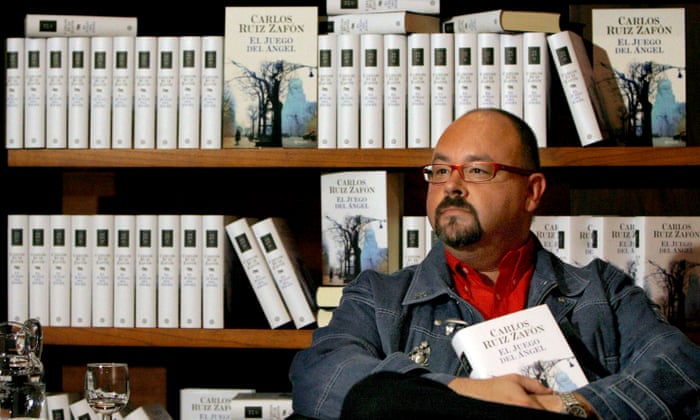
Carlos Ruiz Zafon at the launch of The Labyrinth of the Spirits 
at the Expiatory Church of the Sacred Heart of Jesus in Barcelona. 
Photograph: Pau Barrena

Carlos Ruiz Zafón, author of The Shadow of the Wind, dies aged 55

The bestselling novelist, frequently described as the most-read Spanish author since Cervantes, had been diagnosed with colon cancer in 2018

Alison Flood
Friday 19 June 2020


Carlos Ruiz Zafón, the Spanish author of internationally bestselling novels including The Shadow of the Wind, has died at the age of 55.
The novelist, who was frequently described as the most-read Spanish author since Cervantes, died on Friday at his home in Los Angeles, his publisher Planeta announced. According to Spanish language reports, Ruiz Zafón had been diagnosed with colon cancer in 2018.
Pedro Sánchez, the Spanish prime minister, tweeted: “We have lost one of the world’s most read and most admired Spanish writers. Carlos Ruiz Zafón, a key novelist of our epoch, made a significant contribution to modern literature.”

'Shadow of the Wind' author Carlos Ruiz Zafón dead at 55


Carlos Ruiz Zafón


'Shadow of the Wind' author Carlos Ruiz Zafón dead at 55


By ARITZ PARRA and ANDREW DALTON 
Associated Press
June 19, 2020 


MADRID — Carlos Ruiz Zafón, whose wildly popular 2001 novel “The Shadow of the Wind” led to three sequels and made him one of the world’s most beloved Spanish authors, has died. He was 55.

His Spanish publisher, Planeta, said in a statement Friday that Zafón died in Los Angeles. It gave no cause of death, but Zafón was known to have cancer.


“One of the most read and admired Spanish authors worldwide has left us,” Spanish Prime Minister Pedro Sánchez said on Twitter. “Carlos Ruiz Zafón… leaves an important mark in modern literature. Thank you for letting us travel through your stories.”

“The Shadow of the Wind,” a literary thriller from 2001, was the first in his series “The Cemetery of Forgotten Books.”

The novel, set in Barcelona and mingling reality, fantasy and romance, recounts the son of a bookshop owner’s quest to find the works of a mysterious author and to learn who has been destroying them.


“Every book, every volume you see here, has a soul,” Zafón wrote in the novel in a quote that many were posting on social media after his death. “The soul of the person who wrote it and of those who read it and lived and dreamed with it. Every time a book changes hands, every time someone runs his eyes down its pages, its spirit grows and strengthens.”

The sprawling, detailed storytelling and world-building led some to compare Zafón to Dickens and Tolstoy. And the book’s worldwide popularity as a work of Spanish literature brought him comparisons to Cervantes.

Its 2004 translation into English, heavily praised and promoted by Stephen King, made Zafón an international literary superstar.


Every book has a soul." Carlos Ruiz Zafón - The Angel's Game ...

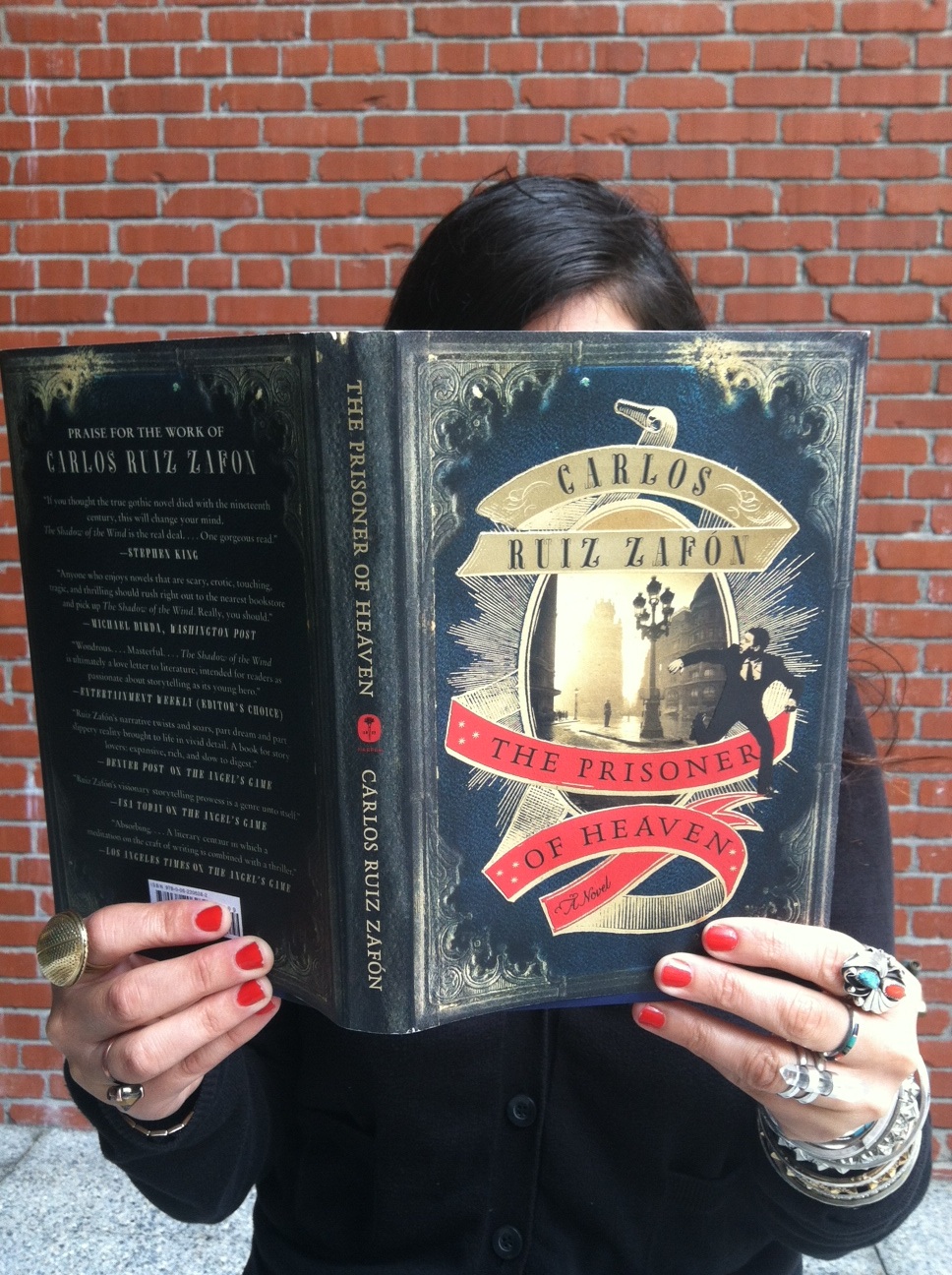
He would spend the next 16 years writing three sequels featuring the same literature-obsessed protagonist Daniel Sempere: 2008’s “The Angel’s Game,” 2011’s “The Prisoner of Heaven,” and 2017’s “The Labyrinth of Spirits.”

“Zafón’s writing is sumptuous and dark and epic,” author Livia Llewellyn wrote on Twitter Friday. “The Shadow of the Wind is one of those novels I return to every couple of years because it’s everything I love about writing and what it can when created by an absolute master.”


Amazon.com: The Angel's Game: A Psychological Thriller ...

Zafón’s works have been translated into more than 50 languages, according to Planeta, and have won numerous prizes.

Born in Barcelona in 1964, the son of an insurance salesman, Zafón worked as a publicist before becoming a full-time writer.


He first gained notice in 1993 with a horror-mystery novel for young adults, “The Prince of Mist.” It would become a trilogy along with 1994’s “The Midnight Palace” and 1995’s “The Watcher in the Shadows.”

Zafón was also an accomplished amateur pianist and composer — he humbly called it his “hobby” — who would sometimes play at his public readings and discussions.

He moved from Barcelona to Los Angeles in the 1990s and briefly worked as a screenwriter, but had far greater success by returning to novels. He split his time between the two cities for the rest of his life.


The gothic novel is not dead: Carlos Ruiz Zafon's The Shadow of ...

In a personal essay on his website called “Why I Write,” Zafón said it was because he had no other choice.

“I am in the business of storytelling,” he wrote. “I always have been, always will be. It is what I’ve been doing since I was a kid. Telling stories, making up tales, bringing life to characters, devising plots, visualizing scenes and staging sequences of events, images, words and sounds that tell a story. All in exchange for a penny, a smile or a tear, and a little of your time and attention.”

PANTAGRAPH


DE OTROS MUNDOS

RIMBAUD